Call us toll free:
+86 755 2306 6423
Shenzhen 3Mtek Innovation Technology Company Limited
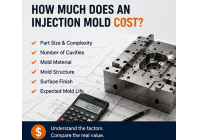
One of the first questions customers ask when considering injection molding is:
"How much will the mold cost?"
It is an important question, but there is no universal price for an injection mold.
Two plastic products of similar size can require completely different tooling investments because mold cost depends on many technical factors.
Understanding these factors can help you compare quotations more effectively.
The size and shape of the product directly influence mold construction.
A larger product generally requires a larger mold, while a complex product may require additional mechanisms and more complicated machining.
Features such as:
Deep cavities
Undercuts
Threads
Sliders
Lifters
Thin walls
Complex surfaces
can increase tooling complexity.
A mold can be designed with one or multiple cavities.
A single-cavity mold produces one part per injection cycle.
A multi-cavity mold can produce several parts during the same cycle.
For high-volume production, multiple cavities may improve productivity and reduce the molding cost per part.
However, more cavities also mean a more complicated and expensive mold.
The correct choice depends on expected production volume and the required production economics.
The steel or other tooling material used in the mold affects both cost and durability.
Different applications may require different levels of mold durability.
For a product with relatively low production requirements, a simpler tooling solution may be sufficient.
For long-term, high-volume production, a more durable mold construction may be justified.
A simple mold structure is generally easier to manufacture than a complex mold.
If the product requires sliders, lifters, inserts, special ejection systems, or other mechanisms, additional machining and components may be required.
This is why two quotations for apparently similar products can sometimes be very different.
The product's appearance can also affect tooling cost.
Depending on the customer's requirements, the mold may need:
Polishing
Texture
EDM finishing
Special surface treatment
Cosmetic control
A high-quality cosmetic surface often requires additional tooling work and inspection.
The required mold life is another important consideration.
If you only expect a limited number of production cycles, there may be no reason to build the same tooling specification as a product expected to remain in production for many years.
The appropriate mold specification should therefore be based on realistic production expectations.
A common mistake is to collect several quotations and simply choose the lowest number.
But a mold quotation should be evaluated together with its specifications.
For example:
What steel is being used?
How many cavities?
What mold life is expected?
What mechanisms are included?
What surface finish is required?
What production volume is the mold designed for?
What sampling and modification process is included?
These questions make a price comparison much more meaningful.
A mold is a production asset.
If the tooling is not suitable for the expected production volume, the initial saving may eventually be offset by maintenance, modifications, production limitations, or replacement tooling.
On the other hand, over-specifying a mold can also result in unnecessary investment.
The goal is to find the appropriate balance.
At 3MTEK INNOVATION, we review the product design, material, production requirements, and expected volume before recommending a tooling solution.
This allows customers to understand not only how much the mold costs, but also why it costs that amount.
A good mold quotation should explain the tooling solution—not just give you a number.